Google Ads or SEO: Which is better for a new business?
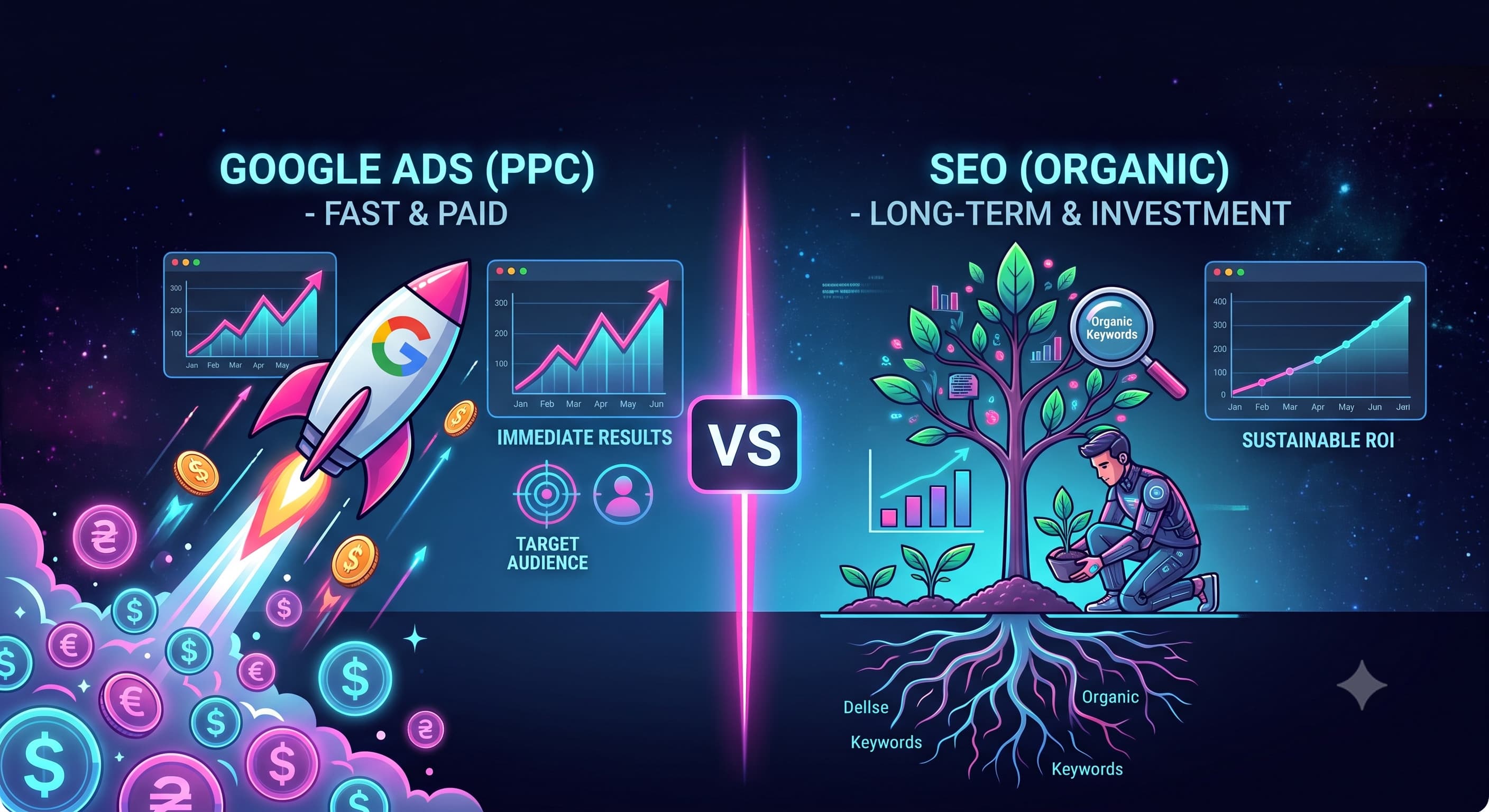
After launching a new website, every business owner faces a core question: how to attract the first customers? The two primary channels remain Google Ads (PPC) and Search Engine Optimization (SEO). Both work, but they distribute risk, time, and budget very differently — and a wrong call at the start often means either wasted ad spend with nothing to show for it, or months spent waiting for organic traffic that never shows up. This article gives you an honest comparison, without 'SEO is better for everyone' or 'ads are a rip-off', including real timelines and exactly what each budget goes toward.
Google Ads (PPC): Fast Start, Paid Traffic
Contextual advertising operates on a 'pay for instant results' principle. It is ideal when you need sales today, not three months from now once your site climbs to the top of search.
- Instant results: Your ads appear at the top of search results right after setup and payment.
- Precise targeting: Ability to show ads strictly to your target audience by specific cities, hours, and search queries.
- Main downside: Traffic stops the moment your advertising budget runs out.
SEO: Long-Term Investment with High ROI
Search Engine Optimization is the process of adapting your website to Google algorithm requirements to gather free organic traffic for months and years after the active work has stopped.
- Lasting effect: Even if active optimization work pauses, the site keeps bringing leads for years.
- Higher trust: Users click on organic search results far more often than on sponsored ad tags.
- Technical foundation: SEO demands a blazingly fast and quality site (for instance, built on Next.js).
How long each option takes to show results
Google Ads delivers your first clicks literally on launch day — ad review usually takes a few hours, rarely more than a day. But that doesn't mean instant profit: the first 1-2 weeks go into gathering data and filtering out underperforming keywords, and real optimization of bids and audiences shows a stable result closer to the one-month mark. SEO operates on a different timeline entirely: the first movement in rankings becomes visible 6-8 weeks after technical optimization and content publication, and a genuinely stable stream of organic traffic is typically 4-6 months of consistent work. That's why combining both channels isn't just a hedge — it closes the gap between the instant results of ads and the slower, but free, growth of SEO.
Where the budget goes in each option
In Google Ads, budget splits into two parts: the actual ad bid (money that goes directly to Google for every click or impression) and the fee for a specialist to set up and manage the campaign. You always control the bid yourself and can stop it at any moment — which is exactly why Google Ads is so flexible for testing new business directions or seasonal offers with a hard deadline. In SEO, the budget goes almost entirely into labor: technical audits and bug fixes, writing content around specific search queries, building internal links between pages of the site. There's no separate 'traffic supplier fee' — you're paying for work, not clicks, which is why SEO is usually cheaper on a monthly basis once it reaches stable rankings, even though it takes longer to ramp up. Both options demand a real specialist, not a one-time setup you can forget about — both Google Ads and SEO degrade without ongoing attention.
How to know a channel is actually working
The most common mistake at the start is judging a channel 'by eye' — by views or likes — instead of by real leads. Without properly configured analytics (Google Analytics 4, conversion goals, UTM tags on every ad), there's no honest way to answer 'where did the client who called yesterday actually come from' — and without that answer, every budget decision is a guess, not a data point. For Google Ads, that means tracking not just clicks but specific actions: a call, a submitted form, a Telegram message. For SEO, it means tying organic traffic from specific pages to those same actions, so you know which blog post or service page actually brings in clients and which one just exists for show. Without this layer of analytics, both channels are equally easy to over- or under-value — decisions like 'turn off ads, it's too expensive' or 'drop SEO, it's too slow' are usually made because this data is missing, not because the channel genuinely underperformed.
Verdict: Which option should you pick?
The best strategy for most new businesses is a hybrid, not an either/or choice. At the start, you run Google Ads to land your first clients and test hypotheses (which ad copy, which landing pages convert better) within a week or two. In parallel, you build up SEO — using that same site, the same analytics, and the same real search-query data that the ads surfaced to inform a content plan. A few months in, SEO starts bringing traffic for free, and the ad budget can be trimmed or redirected toward new business directions. The key is not to pick a channel once and forget it, but to regularly check both against real lead numbers, not gut feeling. If your budget is genuinely limited and you have to pick just one, start with whichever matches your planning horizon: Google Ads if you need sales this month, SEO if you're building for the long run and can invest in content before the first results land.
Ready to put this into practice?
Let's discuss your project and find the right solution for your business.