How much does Next.js website development cost in 2026?
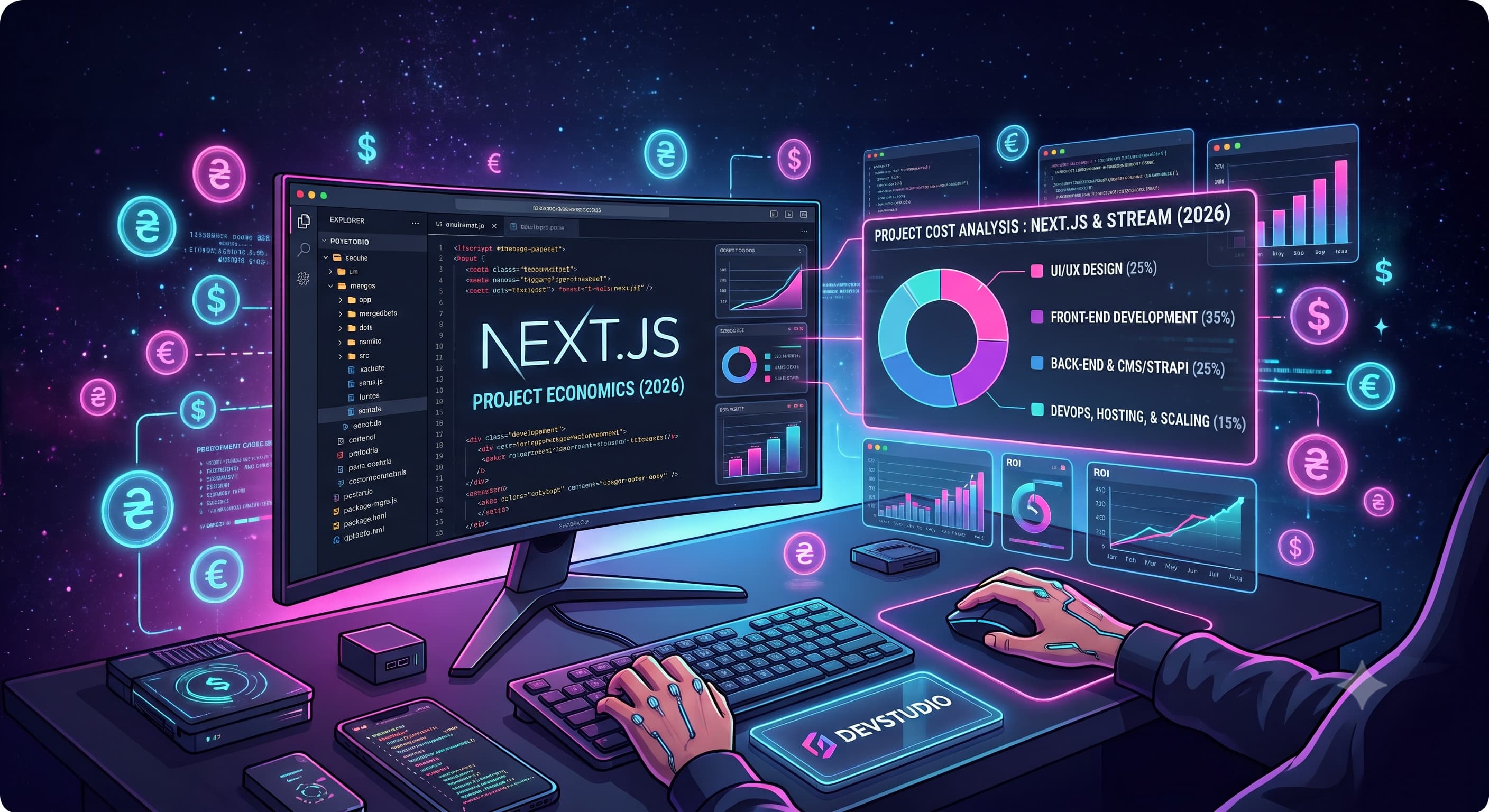
When planning to launch a new website or web app, businesses always face two questions: which tech stack to choose, and how much it will cost. Next.js has become the de facto standard for modern web development thanks to its load speed, built-in SEO optimization, and architectural flexibility — Google, Netflix, TikTok, and hundreds of smaller products have already moved to it. But for a small or mid-sized business owner, 'how much will this cost' rarely has a clean answer — too much depends on the actual scope. In this article, we'll break it down honestly: what real development costs are made of, what two typical scenarios cost in practice, and where business owners most often overpay.
What shapes the cost of development?
Project pricing isn't pulled out of thin air, and it's not a 'magic number' an agency names at random. It's formed by a sequence of stages, each of which takes a specialist real time to complete:
- UX/UI Design (20-25% of budget): Thoughtful structure, responsive layouts, and intuitive navigation.
- Frontend Development (35-40%): Building component-based interfaces in Next.js, animations, speed optimization.
- Backend & CMS (25-30%): Admin panel integration (e.g., Strapi), API setup, and databases.
- Testing & DevOps (10-15%): Server setup (Vercel / VPS), domain mapping, and security.
What it actually costs: two real-world scenarios
Instead of a vague 'from X to Y' range — two concrete examples from practice. A one-page landing site with custom design, mobile responsiveness, and basic technical SEO typically costs from 5,000 UAH and launches in 1-2 weeks — enough to present a single service or product with a clear call to action. A multi-page website — with a dedicated page for each service (up to 10 pages), a blog for SEO articles, and connected analytics (Google Analytics, Search Console) — starts from 11,000 UAH, with monthly upkeep (content updates, technical support, backups) adding around 1,800 UAH per month. The price difference always comes down to scope: number of pages, whether you need a CMS to edit content yourself without a developer, and whether third-party integrations are required (CRM, payment systems, booking systems).
Why is investing in Next.js worth it?
Unlike site builders or legacy CMSs without serious optimization, custom Next.js development gives you full ownership of your code — no dependency on someone else's platform that might raise its subscription price or limit functionality tomorrow. You get top PageSpeed scores out of the box thanks to server-side rendering (SSR/SSG), and a far lower risk of getting hacked compared to popular CMSs, for which new vulnerabilities and plugin conflicts surface every week after every update. This directly reduces future advertising costs: Google officially factors load speed (Core Web Vitals) into ranking, so a fast site climbs organically, and paid traffic converts better because visitors don't leave while the page is still loading. Over the long run, this often works out cheaper than a 'free' CMS that keeps racking up paid plugins and hours spent keeping them compatible with each other.
Common mistakes that inflate the budget
In practice, budgets balloon less because of the development itself and more because of decisions made before it even starts:
- A 'moving target' brief with no final list of pages and features — changes made mid-development cost 2-3x more than the same changes made at the planning stage.
- Choosing a legacy CMS 'because everyone does' without considering speed — a year or two later you end up paying for a full migration to a faster stack, effectively paying for development twice.
- Treating hosting and domain as an afterthought — VPS, SSL certificate, and mail services aren't included in design and build pricing by default, and should be agreed on upfront, not after launch.
- Treating technical SEO as an 'optional extra' — retrofitting URL structure, meta tags, and structured data after the fact is always more expensive and slower than building it into the architecture from day one.
- Comparing quotes by final price alone, with no breakdown — two quotes for 'the same website' can differ precisely because one of them skips everything listed above.
Does spending stop after launch?
A finished website isn't a one-time purchase like furniture — it's closer to a car: it needs regular upkeep. Security updates for libraries and components, SSL certificate renewal, database backups, server uptime monitoring — all of this is ongoing monthly work, even if the site looks unchanged on the surface. That's exactly why our fixed packages include a 3-month warranty period: most technical issues surface not in the first week after delivery, but during real-world use, once hundreds of different browsers, devices, and connection speeds start hitting the site. When planning your budget, it's worth accounting for this line item upfront rather than treating it as an unpleasant surprise six months in.
What's included in the fixed packages
We deliberately moved away from custom 'quote on request' pricing, which often hides markup in the back-and-forth negotiation. Both of our packages have a fixed, known-upfront price: custom design (not a template), mobile responsiveness, SSL and technical SEO out of the box, plus a 3-month guarantee after launch for technical fixes. The multi-page package adds a blog with SEO articles and connected analytics on top — exactly the tool that lets you track whether the site is actually bringing in leads, not just 'looking nice'.
Ready to put this into practice?
Let's discuss your project and find the right solution for your business.